
"Bigger is better" has ruined more Texas air conditioners than hail, and it isn't close.
Here's the myth: Texas is brutally hot, so you should round your AC size up — get the 5-ton instead of the 4, muscle through August, sleep cold. It sounds like common sense. It's also backwards, and it's why so many Texas homes are simultaneously expensive to cool and clammy to sit in.
An oversized AC doesn't cool better. It cools too fast — blasting the thermostat to temperature in ten minutes and shutting off before it's done the second half of its job, which is wringing humidity out of the air. Short cycles mean cold-but-humid rooms, that cave-like dampness, mold-friendly closets, higher bills from constant restarts, and a compressor aging in dog years from start-stop abuse.
Undersizing has obvious problems — a system running flat-out at 5pm in August and losing ground. But the industry's actual epidemic is the opposite one, because oversizing is the error nobody calls back to complain about the day after install. The house got cold, didn't it?
The fix has existed since the 1950s: a Manual J load calculation — the room-by-room accounting of what your specific house actually gains in heat on a design day. Every good installer runs one. A depressing share of installers skip it and size off your old unit's sticker, faithfully copying whatever mistake was made in 1998.
Skip the search-ad roulette. Tell us once, and we'll match you with a licensed, vetted Central Texas pro — price quoted before any work.
This guide explains what Manual J measures, roughly where Texas homes land, and how to make sure your replacement gets sized by math instead of by habit.
Heat enters your house through predictable paths, and Manual J prices each one: window area and orientation (west-facing glass is the Texas heavyweight), insulation levels in attic and walls, air infiltration through the envelope, ceiling heights, roof color and material, shading from trees or neighbors, duct location (a 130° attic taxes everything moving through it), and internal gains from people and appliances.
The output is a heat gain number in BTUs for the hottest design conditions your area normally sees — for Austin, roughly a 99°F design day. Your equipment gets sized to that, in tons (one ton = 12,000 BTU/hr of cooling).
Two identical floor plans can need different equipment: flip the same 2,200 sqft plan so its glass wall faces west instead of north, skimp the attic insulation, and you've added half a ton of load. That's why the sqft-per-ton shortcut — usually quoted as "500–600 square feet per ton" — is a starting guess, not an answer.
| Home | Typical load | Typical equipment |
|---|---|---|
| 1,200 sqft, decent envelope | 24,000–30,000 BTU | 2–2.5 tons |
| 1,800 sqft, 2000s tract build | 30,000–42,000 BTU | 2.5–3.5 tons |
| 2,400 sqft, good insulation | 36,000–48,000 BTU | 3–4 tons |
| 3,000 sqft, big west glass | 48,000–60,000+ BTU | 4–5 tons, often zoned |
Notice the overlaps — that's the honest part of the table. A tight 2,400 sqft build can need less cooling than a leaky 1,800 sqft one. Hill Country customs with wall-of-glass lake views routinely blow past these ranges; well-shaded central Austin bungalows with new attic insulation come in under them.
If your current system is dramatically off from these ranges in either direction, that's worth mentioning to your installer — along with the honest symptoms: which rooms lag, whether the house feels damp, whether the system ever seems to rest.
Oversized tells: cools quickly but the house feels damp or musty; system rarely runs longer than 10 minutes; rooms near the thermostat freeze while far rooms lag; humidity sits above 55% indoors even when it's cool; utility bills higher than similar neighbors'.
Undersized tells: runs continuously on hot afternoons and still loses a degree or two; upstairs never quite gets there; bills high because the system never cycles off. (Caution: these same symptoms can mean a failing system or leaking ducts rather than wrong size — which is exactly what a load calculation plus duct inspection untangles.)
The bittersweet news if you're oversized: your replacement may be cheaper than you feared. Downsizing a ton at replacement time — with the math to prove it — buys better comfort and a smaller invoice at once. It happens constantly when someone finally runs the numbers on a 1990s tract home.
Part of why sizing was so unforgiving historically is that single-stage equipment has two settings: everything and nothing. Two-stage and variable-speed systems soften the penalty — they can run at 40–70% capacity for long, quiet, dehumidifying cycles and still have full power for the worst afternoons.
That makes them particularly forgiving in Texas's real problem cases: big open floor plans, wall-of-glass rooms, and two-story homes where the load swings hard through the day. It's also why the mid-tier two-stage systems in our replacement cost guide punch above their price in comfort.
They are not, however, a license to skip the load calculation. Variable capacity forgives a half-ton miss, not a two-ton one.
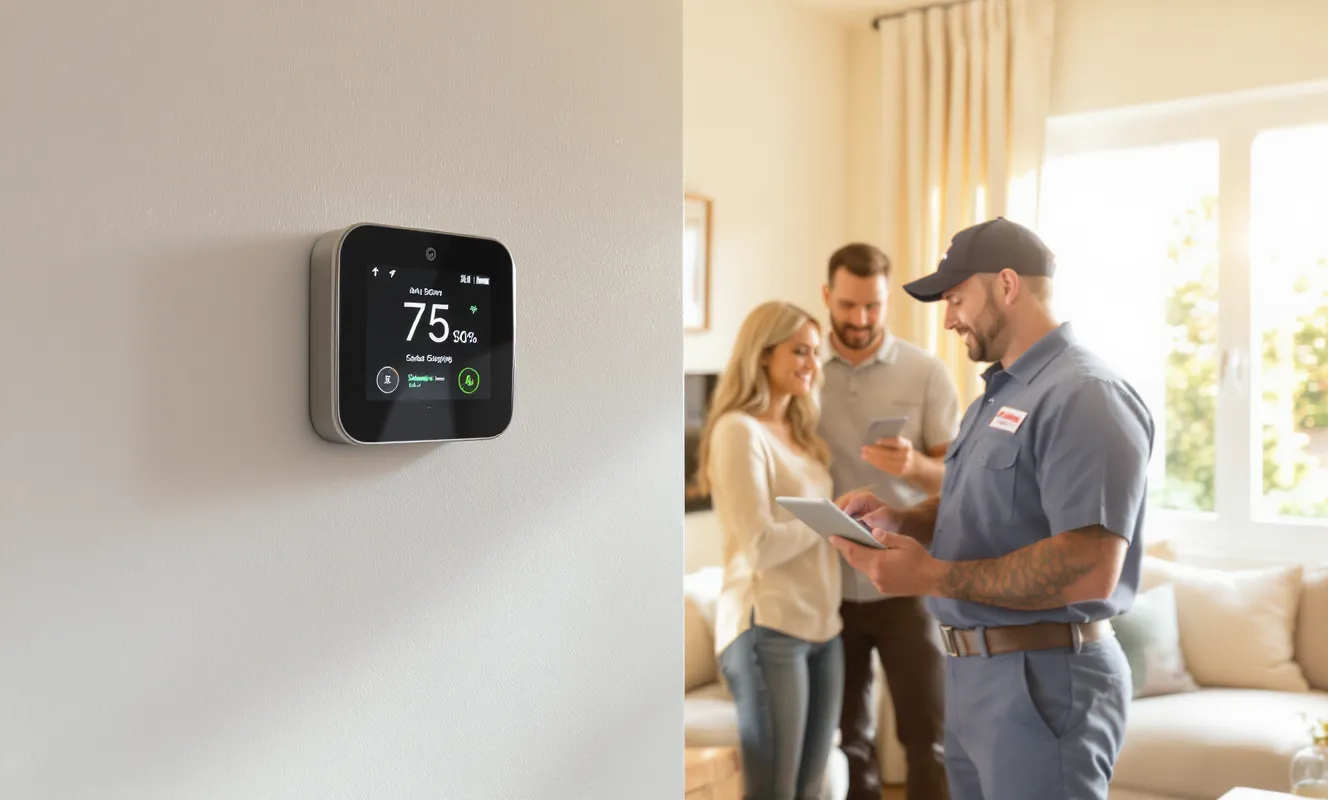
Ask one question of every bidder: "Will you run a Manual J, and can I see it?" The good ones say yes without flinching — many do it on a tablet during the visit. If the answer is "we'll just match what you've got," you've learned something important for free.
Expect the visit to include measuring windows, checking attic insulation, and asking about hot rooms — that's what the inputs require. A load calc produced without anyone entering your attic is a form, not a measurement.
And insist the ducts get looked at in the same visit: sizing the equipment right and then pushing the air through leaky, undersized ducts is buying a great engine for a car with flat tires. The installers in our network treat the load calc and duct inspection as the non-negotiable start of every replacement quote — in Austin, Georgetown, Dripping Springs, and everywhere between.
A few local patterns deserve their own warnings. Trap one: the west-facing great room. Central Texas builders love tall windows on the sunset side, and that single design choice can add half a ton of late-afternoon load that a whole-house average misses — the room needs zoning or dedicated capacity, not a bigger blower pushing more cold into the rest of the house. Trap two: the converted garage or bonus room over it. These spaces were never in the original load design; bolting them onto the existing system undersizes everything downstream, which is why the mini-split was invented. Trap three: the 130° attic duct run. Uninsulated or sun-baked ductwork adds effective load the calculation must account for — and is often cheaper to fix than to out-muscle with tonnage.
Trap four is seasonal: sizing decisions made during a heat-wave emergency. When the house is 88° and the installer can come Tuesday, nobody's running room-by-room math — which is precisely how the last oversized system got installed. If your AC is limping, get the load calculation done now, in comfort, so the eventual replacement is a scheduled project instead of a panic buy.
Homeowners who fix a chronic oversize describe the same things: the system runs longer but the house finally feels dry — 45–50% indoor humidity instead of 60; bedroom temperatures stop whiplashing; closets and bathrooms lose their musty edge; and the utility bill drops noticeably despite more runtime hours, because long steady cycles beat constant hard restarts. The compressor lasts longer for the same reason your car engine prefers highway miles to stop-and-go.
Fixing an undersize is less subtle: the 5pm losing battle just stops. Either way, the point of the math is a house that holds 74° on a 103° afternoon without drama — which is achievable in nearly every Central Texas home, at the right tonnage, with ducts that deliver it. That's the standard worth holding your installer to, and the one our network holds by default.
Everything above assumes an existing house, but the same math governs new builds and additions — with one difference: you have no old unit to anchor on, which is a blessing. Builders in fast-growing corridors like Jarrell and Hutto often spec equipment by floor-plan template rather than per-lot orientation, which is how two identical homes on opposite sides of the same street end up with identical tonnage and very different August afternoons. If you're building, ask for the load calculation before drywall; if you're adding a room, insist the addition gets its own load math rather than a boosted blower speed. Ten minutes of arithmetic at the plan stage beats years of compensating afterward.
Size is the one AC decision you can't cheaply undo — refrigerant can be recharged and thermostats can be swapped, but wrong tonnage is wrong for fifteen years. The playbook is short: insist on a Manual J with your replacement quote, make sure someone actually enters the attic to produce it, get the ducts inspected in the same visit, and let two-stage equipment smooth whatever your floor plan makes difficult. Homes across Central Texas — from Leander tract builds to Lakeway lake houses — get this right every week, and the difference shows up on the first 100-degree afternoon and every one after it. Measure first. Then buy.