
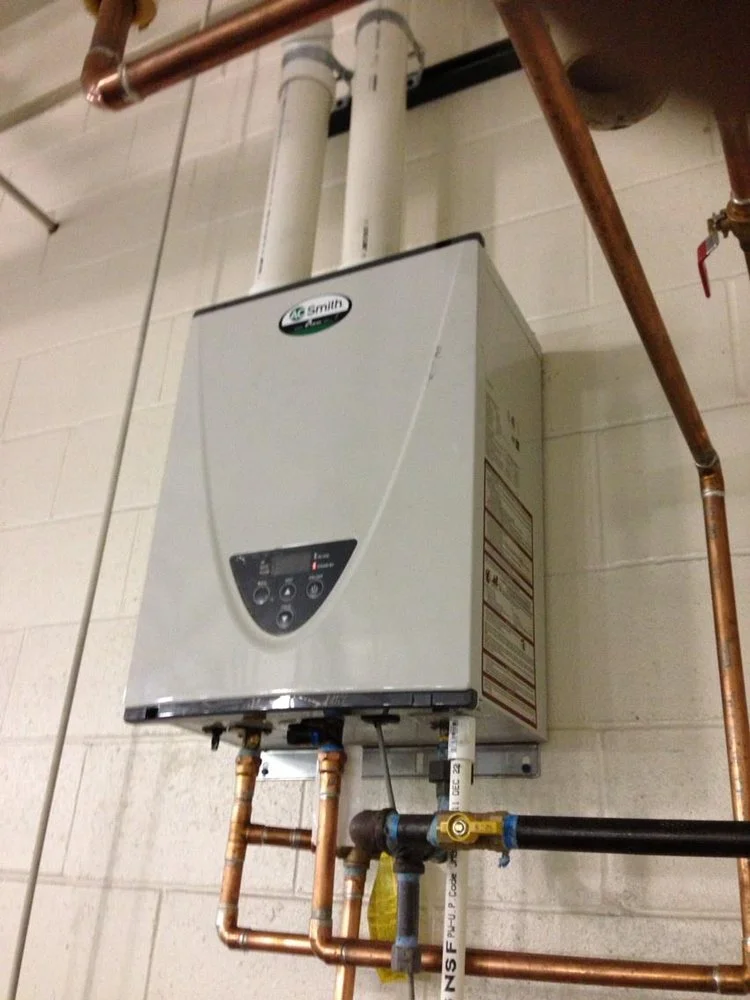
When your water heater dies in Central Texas — and in our water, it will die younger than the brochure promised — you get about 48 hours to make a 15-to-20-year decision. Cold showers are a remarkable clarifier, and a terrible negotiating position.
So it's worth having this argument now, while your current tank still limps along: tankless or another tank?
You've probably heard both pitches. Tankless: endless hot water, wall-mounted, sips energy, lasts twenty years. Tank: half the upfront cost, dead-simple, every plumber alive can service one before lunch. Both pitches are true. Both leave out the part that decides the question in this region.
That part is our water. Central Texas water runs hard to very hard — dissolved limestone, the Hill Country's signature — and hardness is the single biggest variable in how both technologies age here. It shortens tank lifespans through sediment buildup, and it will flat-out murder a tankless heat exchanger that isn't installed and maintained for local conditions.
Which means the national comparison articles you've skimmed are missing the deciding factor. The right answer in Portland is not automatically the right answer in Georgetown, where the water is harder than the granite courthouse steps.
Skip the search-ad roulette. Tell us once, and we'll match you with a licensed, vetted Central Texas pro — price quoted before any work.
Here's the Central Texas version of the argument, with real installed prices, real lifespans in our water, and an honest accounting of which households each option fits.
| Factor | Tank (40–50 gal) | Tankless (gas, whole-home) |
|---|---|---|
| Installed cost | $1,400–$3,000 | $3,500–$6,500 |
| Lifespan in local water | 8–12 yrs (6–8 untreated) | 18–22 yrs with maintenance |
| Hot water supply | Fixed, then recovery wait | Continuous at rated flow |
| Energy use | Standby losses 24/7 | Heats only on demand (~$8–15/mo savings) |
| Space | Closet/attic footprint | Suitcase on a wall |
| Hard-water vulnerability | Sediment; shortened life | Scale in exchanger; needs descaling |
| Annual maintenance | Flush (often skipped) | Descale (not optional here) |
Read the lifespan row twice — it's the quiet headline. In our water, an untreated tank often dies before its warranty story implies, while a properly maintained tankless is a two-decade appliance. Cost-per-year of service, the gap between the technologies is much narrower than the sticker suggests.
But the fine print in the maintenance row is the deciding condition: 'with maintenance' is doing heavy lifting on the tankless side. Skip descaling in Georgetown-grade water and you can scale a heat exchanger into failure in a handful of years — voiding warranty terms along the way, since several manufacturers key coverage to water hardness.
In a tank: dissolved minerals precipitate when heated and settle as sediment. The rumbling and popping you hear from older tanks is water boiling underneath that layer. Sediment insulates the burner from the water (efficiency drops), traps heat against the tank floor (steel fatigue), and buries electric elements (burnout). Annual flushing helps early; once several inches accumulate, the countdown is running.
In a tankless: the same minerals scale up inside narrow heat-exchanger passages — the component that is the appliance. Flow drops, temperatures oscillate, error codes appear, and unaddressed, the exchanger fails at four figures to replace. The defenses: isolation valves installed with the unit (insist on this), annual vinegar-loop descaling ($150–$250 as a service, or DIY-able), and ideally a softener upstream, which protects the whole house and relaxes the maintenance clock at once.
That's why the honest local answer isn't 'tankless is better' or 'tank is safer' — it's that tankless is a commitment to a maintenance rhythm, and a tank is a commitment to earlier replacement. Price both commitments, not just the hardware.
Tankless wins: households that outrun a 50-gallon tank (teenagers, soaking tubs, back-to-back showers); homes where the tank squats in premium closet space or, worse, in an attic above finished rooms — a tankless on the wall retires that flood risk entirely; owners planning to stay 10+ years, who collect the lifespan dividend; and anyone already installing a softener, which removes the technology's main local weakness.
Tank wins: tight budgets and near-term moves — you won't recoup a tankless premium you don't stay for; rentals, where maintenance discipline is someone else's optimism; households of one or two whose 40-gallon tank never runs out anyway; and electric-only homes, where whole-house electric tankless demands panel capacity most houses don't have (heat pump water heaters are the better electric upgrade — a topic for another guide).
The tiebreaker case — replacing an attic tank in a two-story house — leans tankless harder than people expect. Attic tank failures are the plumbing disaster that keeps adjusters employed, and moving the appliance to a garage wall converts a ceiling catastrophe into a non-event.
Tank replacement in Central Texas runs $1,400–$3,000 installed depending on gas vs electric, location (attics cost more), and code catch-up — expansion tank, pan and drain, strapping, venting. Budget the code items; they're not padding, they're the difference between an install and a liability.
Tankless conversion runs $3,500–$6,500: the unit, stainless venting, isolation valves, condensate handling, and very commonly a gas-line upsize, since tankless burners draw 150–200k BTU against a tank's 40k. If a quote doesn't mention gas sizing, the quoter didn't look — see our tankless install pages for what a proper scope includes.
Lifetime math on a 20-year horizon for a family of four: two tanks plus energy and flushes lands remarkably close to one tankless plus descaling and energy savings — typically within $500–$1,000 either way. Which is the real conclusion: over time the money roughly washes, so choose on hot-water behavior, space, risk tolerance, and maintenance honesty instead of sticker price.
Answer four questions. One: do you actually run out of hot water — monthly, or twice a year? Two: where does the current tank live, and what's below it when it fails? Three: will you own this house in 2036? Four: will descaling actually happen — on a calendar, not in theory?
Running out regularly + staying + maintenance-willing = tankless, ideally with a softener. Never running out + maybe moving + maintenance-averse = quality tank, installed to code, flushed annually, replaced without drama in a decade. Both are respectable answers; only pretending about question four is not.
Whichever way you land, get it quoted before the current tank forces the issue — a planned swap costs less and chooses better than an emergency one. A licensed local pro can price both paths on one visit, and you'll make a 20-year call with dry feet.
Theory helps, but most people recognize themselves faster in scenarios. The Leander family of five whose 50-gallon tank taps out nightly between swim practice showers and a load of towels: tankless, sized for three simultaneous fixtures, and the complaint disappears rather than improves. The Sun City couple in Georgetown whose tank has never once run empty: a quality replacement tank, installed to code with an expansion tank and a fresh pan, flushed each spring — spending the tankless premium there buys nothing they'd ever feel. The South Austin landlord with a fourplex: tanks, unapologetically, because maintenance discipline across tenants is a fantasy and simple beats optimal. The Lakeway household mid-remodel with a tank hogging the closet destined to become a wine fridge: tankless on the garage wall, and the closet wins twice.
And the one that generates the most emergency calls: the two-story home with the original builder-grade tank sitting in the attic, now at year eleven. That homeowner shouldn't be reading comparisons — they should be scheduling. Whichever technology they choose costs a fraction of the ceiling-and-flooring claim the current tank is actively planning.
Four questions separate a real proposal from a guess. 'What's my measured water hardness, and how does the quote account for it?' — the answer should involve a number in grains, and for tankless, valves and a treatment conversation. 'If tankless, does my gas line support the burner, and is the upsize in the quote?' — missing gas math is the classic tankless change-order. 'If tank, which code items are included?' — expansion tank, pan and drain, strapping, and permit should all be line items, not surprises. And 'what does the manufacturer's warranty actually require of me?' — because in this water, both technologies carry maintenance conditions, and knowing them on day one is free while discovering them in a claim denial is not. A quoter who answers all four crisply is the one you want in your attic — and that vetting is exactly what our network does before a name ever reaches you.
And if you're reading this with a tank actively weeping onto the garage floor: shut the cold inlet valve, kill the breaker or gas valve, and get the form in marked urgent. The technology debate can happen this weekend; the water on the floor can't.
And keep the decision's paper trail — hardness number, sizing math, warranty terms — in the same folder as your install documents. Year-nine disputes are won by the households who kept the receipts, in this category more than most.