
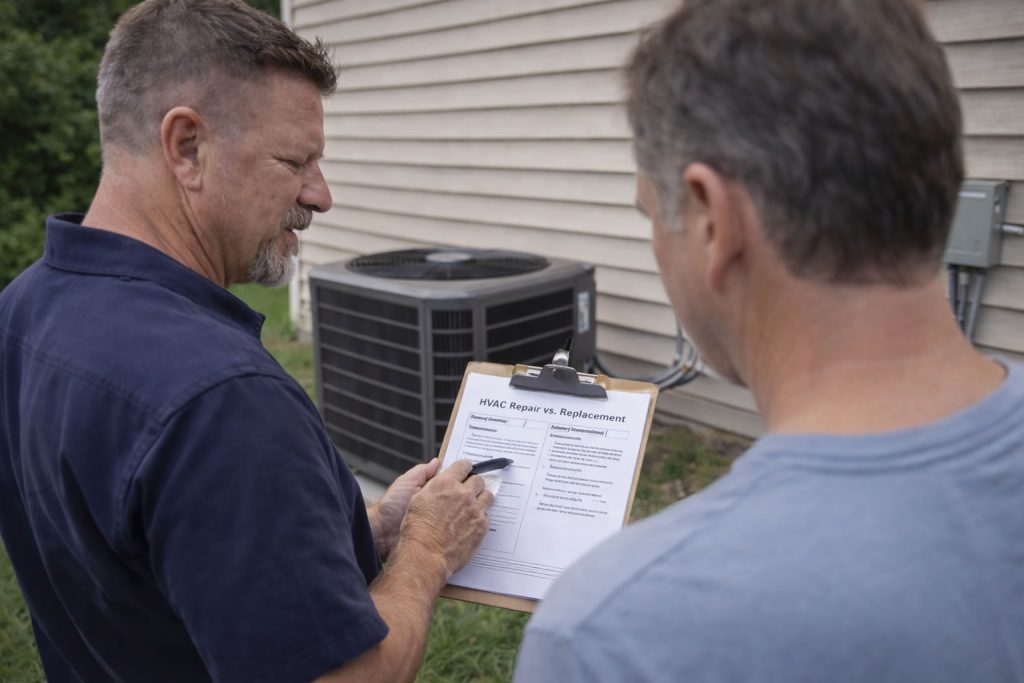
Your AC died at 4pm on a Friday in July, the thermostat says 84 and climbing, and every company you call either doesn't answer or quotes you a "diagnostic fee" that tells you nothing about what this is actually going to cost.
That knowledge gap is expensive. When you don't know that a capacitor is a $200-something fix, a $700 quote for one sounds plausible — especially at 9pm with kids trying to sleep in a hot house. Repair pricing in Central Texas isn't a mystery to the people doing the repairs. It's only a mystery to you.
So let's fix that. Below are the real ranges Central Texas homeowners paid in 2025 and are paying in 2026, organized by the part that failed and the symptom you're seeing — plus the three questions that expose a padded quote in under a minute.
One thing to know up front: prices here run slightly above national averages. Demand does that. When a metro area logs 40+ triple-digit days and every AC in a subdivision was installed the same year, summer repair calendars fill by 10am and pricing reflects it. That's also why the cheapest month to fix your AC is October — more on that below.
A quick note on how we know: Beaver matches Central Texas homeowners with licensed, vetted local contractors every day, which means we see the quotes — the fair ones and the other kind. Nothing below is theoretical.
Skip the search-ad roulette. Tell us once, and we'll match you with a licensed, vetted Central Texas pro — price quoted before any work.
Last thing before the numbers: every range assumes a licensed TDLR contractor, parts and labor included, quoted before work starts. If you're getting numbers that only appear after the work, you have a different problem than a broken AC.
| Repair | Typical Austin-area range | Notes |
|---|---|---|
| Capacitor replacement | $150–$400 | The most common failure in Texas heat |
| Contactor replacement | $150–$375 | Often replaced with capacitor |
| Condenser fan motor | $300–$700 | More for OEM or hard-to-source motors |
| Blower motor | $400–$1,500 | Variable-speed ECM motors at the top end |
| Refrigerant leak repair + recharge | $500–$1,800 | Depends on leak location and refrigerant type |
| Evaporator coil replacement | $1,500–$4,000 | Often triggers the repair-or-replace conversation |
| Control board | $400–$1,200 | Communicating systems cost more |
| Compressor replacement | $2,000–$4,500 | Usually replacement territory on older units |
| Condensate drain clearing | $100–$300 | The cheap fix behind many "leaks" |
Diagnostic fees run $75–$150 around Austin, and reputable companies credit that toward the repair. If a company charges a trip fee AND a diagnostic fee AND doesn't credit either, that tells you how the rest of the invoice is going to go.
Weekend and after-hours emergency calls typically add $100–$250 or shift the labor rate up. That's legitimate — someone is leaving their kid's birthday party to fix your compressor. What's not legitimate is emergency pricing on a Tuesday morning.
Warm air from the vents is the wide-range symptom — it can be a $150 capacitor, a $600 fan motor, or a $1,200 refrigerant job. The giveaway is what the outdoor unit is doing: silent means electrical (cheaper), running-but-not-cooling leans refrigerant (pricier).
Ice on the refrigerant lines usually means low refrigerant or airflow trouble. The repair might be $500–$1,800 for a leak, or $100 for the filter you forgot about. Either way, shut the system off — running it iced can take out the compressor, and now you're in four figures.
Water where it shouldn't be — around the air handler or dripping from a ceiling — is very often just a clogged condensate drain: $100–$300. The panic it causes is wildly out of proportion to the fix. The exception is when it's been leaking a while and there's drywall damage; the AC fix is still cheap, but the ceiling isn't.
Breaker trips every time the unit starts point at a shorted component — often a capacitor or the compressor windings. Stop resetting the breaker. Each restart against a short is a coin flip on the compressor, and that coin flip costs $2,000+ when it lands wrong.
Three structural reasons, none of them a scam. First, runtime: a Central Texas AC logs roughly double the annual hours of a Midwest unit, so parts genuinely wear out faster and demand for techs is higher per capita. Second, seasonality: everyone breaks at once — the first 105° week is a mass-casualty event for weak capacitors, and surge weeks price like surge weeks. Third, housing stock: whole subdivisions built in the same three-year window hit failure age together, which keeps good techs booked.
What this means practically: if your system limped through this summer with a problem you've been ignoring, fixing it in October costs less and books faster than fixing it next June. Off-season is when the good contractors have calendar space and sharp pencils.
It also means a spring tune-up is the highest-ROI money in this whole article — most August failures are visible in April for the price of a service visit.
The rule that holds up: multiply the repair quote by the system's age. Over $5,000–$6,000 of age-dollars — say, a $600 repair on a 10-year-old unit — and you're in think-about-it territory. A $1,800 coil job on a 13-year-old R-410A system is almost always money better put toward replacement, especially with SEER2 efficiency gains cutting summer bills 20–40% versus a 2010 unit.
Under 8 years old? Repair it, almost regardless. Most major components may still be under manufacturer parts warranty — check before paying for parts a warranty covers. You'll still pay labor, but the difference matters.
Be suspicious of a tech who jumps to replacement without showing you the failed part or the readings. Be equally suspicious of one who'll happily take $1,500 to resuscitate a 16-year-old system without mentioning that the compressor is next in line. The honest version of this conversation has two numbers in it, side by side.
One: "What exactly failed, and can you show me?" A real diagnosis has a part and a reading behind it — a capacitor tests out-of-spec measurably, a motor draws measurable amps. "It's real bad in there" is not a diagnosis.
Two: "Is that parts and labor, all-in, and is the diagnostic credited?" Get the total, not the components. Padded quotes hide in the assembly.
Three: "What happens if I do nothing until fall?" Some failures are genuinely urgent; some are August sales theater. An honest tech will tell you which one yours is — and the ones who won't answer that question have answered it.
If you'd rather skip the interviewing entirely: that's the exact reason Beaver's network exists. Every contractor we match is licensed, checked out, and quotes before work — in Round Rock, Lakeway, and everywhere in between.
Numbers in tables are useful; numbers attached to stories stick. Scenario one: a Pflugerville two-story, system running but blowing warm at 3pm on a 104° day. Tech finds a swollen capacitor — visibly domed on top — replaces it, checks refrigerant pressures while he's there, credits the $95 diagnostic. Out the door at $240, cooling restored in under an hour. This is the modal Central Texas repair call, and it's why you should never authorize a compressor conversation before someone has physically tested the capacitor.
Scenario two: a Cedar Park one-story, ice on the lines, weak airflow for weeks beforehand. The freeze was the symptom; the cause was a refrigerant leak at a rusted evaporator coil fitting. Options quoted on-site: $1,450 to repair the leak and recharge, or apply that toward replacement of the 13-year-old system. Homeowner repaired — reasonable at that price — but left with the replacement quote in hand, which is exactly how the conversation should end on a system that age.
Scenario three: a South Austin rental, water dripping through the hallway ceiling below the attic air handler. Panic call, visions of a destroyed ceiling and a five-figure invoice. Actual problem: condensate drain line clogged with algae — a Texas summer classic — cleared and treated for $180. The drywall stain got painted over for less than the emergency plumber the owner almost called instead.
The pattern across all three: diagnosis first, options with numbers, decision made by the homeowner. If your repair experience doesn't follow that shape, change contractors before you change equipment.
Nearly every failure above telegraphs itself. Capacitors read weak on a meter months before they die. Coils rust visibly. Drain lines clog gradually. A $100-something spring tune-up catches all of it while the fix is cheap and the calendar is open — and documented maintenance keeps manufacturer warranties intact, which matters enormously if a big component does fail early.
Filters are the free half of this: monthly checks in summer, every 90 days otherwise, and better airflow immediately. A shocking share of "my AC can't keep up" calls end with a tech holding a filter that looks like a doormat.
One more piece of leverage worth knowing: repair quotes are more negotiable in shoulder season than in July, and multi-repair visits should always be bundled — if the capacitor and the contactor are both marginal, replacing both in one trip costs meaningfully less than two service calls six weeks apart. Ask the tech what else is borderline while the panel is already open. The good ones tell you unprompted, with meter readings to back it up, and let you decide what to do about it.