
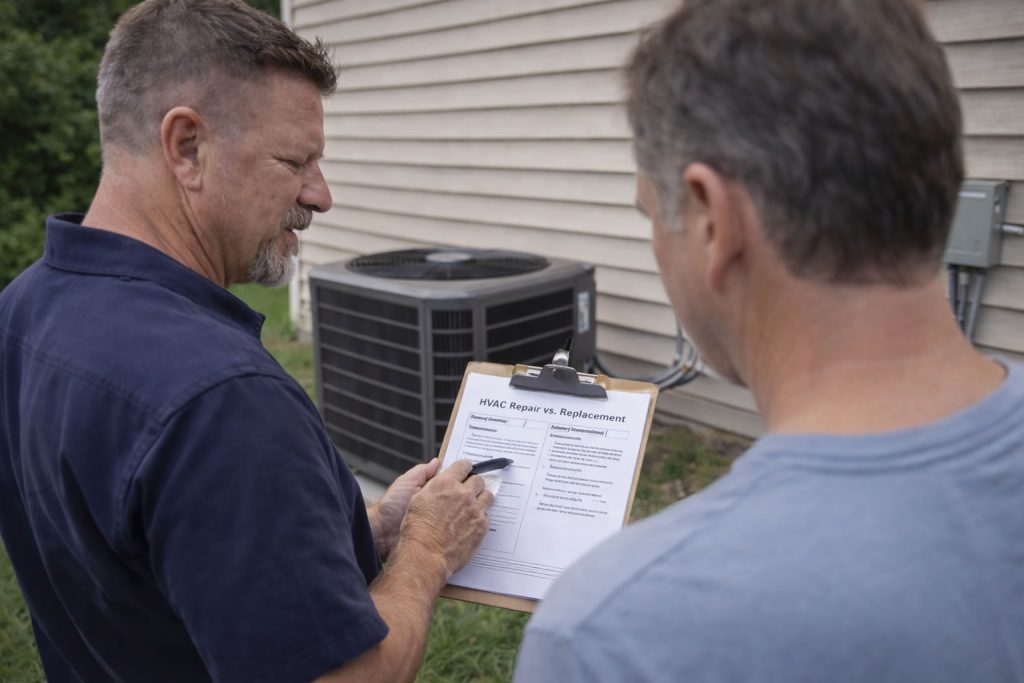
The tech is standing in your garage with a clipboard, the verdict is in — bad coil, weak compressor, pick your poison — and now you're facing the only home-maintenance question that routinely swings five figures on a fifteen-minute decision: fix it again, or replace it?
Here's what makes the moment hard: both answers are sometimes right, both are sometimes sales pitches, and the person delivering the verdict often earns differently depending on which one you choose. Replacement pays commissions; repairs fill route schedules. Neither bias makes the tech dishonest — but the decision is yours precisely because the incentives aren't neutral.
The good news is that this decision has an actual framework — not vibes, not fear, arithmetic — and it fits on an index card. You can run it in the driveway while the tech waits, and it will be right far more often than either your dread of a big invoice or the clipboard's suggestion.
The card reads: multiply the repair quote by the system's age in years. Under $5,000, repair. Over $6,000, replace. In between, look at the symptoms list. A $400 repair on a 6-year-old system: $2,400 — obvious repair. An $1,800 coil on a 13-year-old: $23,400 — obvious replace. The rule works because it prices the real question, which is never 'can this be fixed' (almost anything can) but 'how much runway does this purchase buy.'
Everything else in this guide is the supporting detail: the symptoms that override the math in either direction, the refrigerant wrinkle that changes 2026 decisions specifically, the honest-numbers version of what each path costs in Central Texas, and the tells that you're hearing a pitch instead of a diagnosis.
Skip the search-ad roulette. Tell us once, and we'll match you with a licensed, vetted Central Texas pro — price quoted before any work.
Index card first. Details now.
Tipping toward replace, at any price point: rising bills against identical weather (efficiency is bleeding out somewhere no repair reaches); the humidity slip — cool-but-clammy rooms as compressors and coils lose their edge; short-cycling that no part swap has cured (often an original sizing sin the sizing guide explains — replacement is the one chance to fix it); refrigerant top-offs becoming an annual subscription; and any compressor or coil quote on the wrong side of ten years old.
Tipping toward repair: a specific, named, tested failure with the part in hand ('this capacitor reads 11µF on a 45µF rating' beats 'she's tired'); a system that cooled beautifully until the moment it didn't — sudden failures on healthy systems are usually one component, not a eulogy; and a maintenance history that says the equipment was actually cared for. Well-maintained Texas systems do reach 15; neglected ones fake old age at nine.
The symptom that tips nothing: noise alone. Rattles and hums have cheap causes and expensive ones — get the diagnosis before the philosophy.
Systems installed before ~2023 run R-410A, and the industry has moved to R-454B/R-32. R-410A isn't banned for service and won't be for years — but its cost curve points one direction, and repair economics on refrigerant-intensive fixes (leaks, coils, compressors) worsen accordingly. A $1,600 leak-and-recharge on a 2013 R-410A system is paying premium prices to extend the outgoing platform.
The flip side, honestly: parts-only electrical repairs on R-410A systems carry no refrigerant tax at all. A contactor doesn't care what's in the lines. Don't let anyone wave 'your refrigerant is obsolete' at a $250 electrical fix — that's the fake-urgency script from our SEER2 guide's transition section wearing a different hat.
Net 2026 rule: refrigerant-circuit repairs age the decision by two or three years; electrical repairs don't age it at all.
Repair path: the ranges in our repair cost guide — capacitors and contactors in the low hundreds, motors in the middle hundreds, refrigerant work $500–$1,800, compressors and coils $1,500–$4,500. Add the quiet costs of an aging system: the efficiency gap versus a new SEER2 unit ($30–$80/month in cooling season), and the actuarial reality that the next failure is already scheduled, you just can't read the date.
Replace path: $8,000–$14,000 typical from the replacement guide, minus 25C credits and utility rebates, minus the timing discount if you control the calendar, plus 20–40% cooling-bill relief and a decade of not having this conversation.
Run both as cost-per-year-of-runway and the fog usually lifts: $1,800 into a 13-year-old buying maybe two years is $900/year; $11,000 into fifteen years is ~$730/year before rebates and bill savings. When repair's per-year number beats replacement's, repair with confidence. When it doesn't, stop paying rent on borrowed time.
And insist on seeing both quotes regardless of your lean — a tech who resists producing the comparison has answered a question you didn't ask out loud.
Timing is leverage: if the system limps at all, bridge cheap and buy in the fall trough. Panic is the only truly expensive option in this whole decision tree.
Second opinions are cheap insurance on any four-figure verdict — a $75–$150 diagnostic against a $12,000 decision is the best-priced hedge in home ownership. Vetted, licensed, no-commission-pressure diagnostics are exactly what the network exists to hand you.
And whichever way the card falls, close the loop that got you here: new system or newly repaired, the spring tune-up is what keeps the next version of this decision a decade away, arriving on your calendar instead of in a heat wave. The homeowners who never sweat this choice aren't lucky — they're maintained.
That's the whole framework. Index card, symptoms, wrinkle, numbers, leverage. The clipboard can wait five minutes; make it wait.
A few situations bend the framework often enough to deserve rulings. The just-bought house with a mystery system: no maintenance history means the age-times-cost rule runs conservative — get the tune-up inspection first, let the readings establish what you actually own, then decide. The rental property: cash-flow math favors repairs longer than owner-occupied comfort math does, but Texas tenant heat expectations (and vacancy costs) put a floor under how long limping is acceptable — many landlords replace one summer earlier than the card strictly requires and consider it tenant-retention spending. The home sale on the horizon: buyers' inspectors flag aging systems and negotiate repairs at closing-table prices — replacing six months before listing at trough pricing routinely beats the concession you'd otherwise eat, and 'new HVAC 2026' is legitimate listing copy. The warranty wildcard: parts warranties transfer with registration paperwork more often than people check — a 2017 system's compressor may still be covered parts-wise, converting a $3,800 verdict into an $1,100 labor bill; always verify before authorizing anything big. And the two-system house where one dies: resist replacing both 'while they're here' unless the twin shows its own symptoms — systems age by their own duty cycles, and the second replacement deserves its own October. None of these outrank the index card; they're the footnotes that keep it honest.
Last word on psychology, because it decides more of these calls than math does: the failure that triggers this decision usually arrives on a miserable day, and misery is a terrible negotiator. If you take one habit from this guide, take the pre-decision — run the index card on your system this week, healthy or not, and write down what you'd do at three price points. Households with a pre-decision execute calmly in August; everyone else improvises expensively. The card costs nothing to fill out in advance.